Studr vs. StudyFetch (2026): The Ultimate Student-Centric AI Study Platform Showdown
When you are juggling a heavy academic workload—whether analyzing complex medical science literature or breaking down dense coursework—relying on standard note-taking tools no longer cuts it. Artificial intelligence study platforms have completely transformed how students digest information, turning hours of reading into streamlined, active learning sessions.
Two standout platforms leading this space are Studr and StudyFetch. This comprehensive, deep-dive comparison explores how both platforms function independently and how they stack up against each other to help you choose the right tool for your academic workflow.
Individual Platform Overviews
What is Studr?
Studr is an AI-powered study platform built specifically for speed, focus, and rapid material breakdown. It is engineered to strip away digital clutter and help students digest dense textbooks, syllabi, and research papers with zero friction.
High-Speed Document Parsing: Designed to ingest heavy text documents, PDFs, and lecture outlines, instantly converting them into structured study notes.
Streamlined Active Recall: Generates targeted practice exams and quizzes that pull directly from core definitions and foundational concepts without unnecessary fluff.
Minimalist User Interface: Features a clean, linear layout that reduces cognitive load, allowing users to drop in reading materials and begin studying within seconds.
Cost-Effective Student Accessibility: Focuses its infrastructure heavily on core text processing, passing savings down to students through flexible and affordable pricing tiers.
What is StudyFetch?

StudyFetch functions as an all-in-one, feature-rich virtual campus powered by AI. It is designed to act as a comprehensive digital ecosystem that replaces multiple traditional study habits—such as recording lectures, making manual flashcards, and organizing notes—into a single centralized dashboard.
Multimodal Input Handling: Supports a massive array of file types, including PDFs, PowerPoint presentations, Word documents, handwritten notes, YouTube video links, and direct audio recordings of live lectures.
AI Teaching Assistant (“Baica”): Features an interactive virtual tutor capable of generating synchronized transcripts from audio files and verbally quizzing students to simulate live study group sessions or oral exams.
Adaptive Testing & Spaced Repetition: Includes robust flashcard decks backed by spaced repetition algorithms and practice exams that dynamically adjust question difficulty based on a student’s weak spots.
Comprehensive Digital Ecosystem: Offers an immersive interface equipped with a digital whiteboard, video player, and expansive note repositories.
Core Philosophical Differences in AI Learning
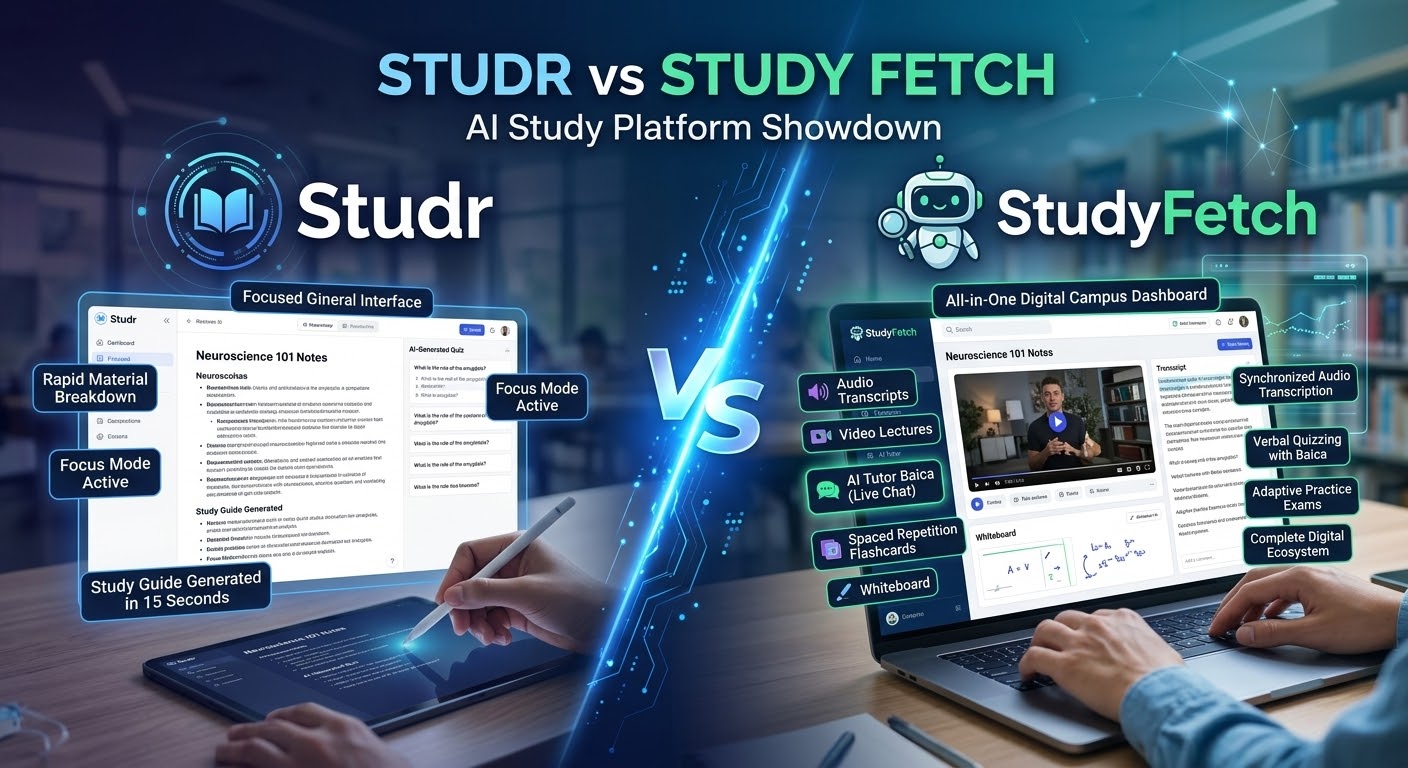
At their core, both platforms aim to turn static course materials into interactive learning hubs, but their underlying execution targets slightly different student workflows. StudyFetch positions itself as an all-in-one virtual campus relying on “Baica” to mimic a human tutor through live audio lectures and massive document-to-quiz pipelines. Studr leans into laser-focused, high-speed material breakdown, engineered for students who want minimal friction when transforming a massive syllabus or dense research PDFs into structured study guides without software bloat.
Document Processing and Multimodal Input Handling
How these platforms ingest your study materials dictates how seamlessly they fit into your daily academic routine.
- StudyFetch supports a vast array of inputs including PDFs, Word documents, handwritten notes, YouTube links, and audio recordings of live lectures to generate synchronized transcripts. However, parsing multi-hundred-page textbooks can occasionally lead to formatting bottlenecks or fragmented text chunking.
- Studr approaches document ingestion with a streamlined architecture optimized for speed and structural clarity, handling PDFs and text blocks exceptionally well while rapidly parsing complex domain terminology without breaking formatting logic.
Practice Testing, Quizzing, and Active Recall Mechanics
Active recall is the gold standard for long-term knowledge retention.
- StudyFetch shines with its interactive quiz engines, adaptive practice exams that mirror real conditions, and deep integration with spaced repetition flashcard algorithms. Its AI tutor Baica can also verbally quiz you to simulate an oral examination.
- Studr focuses on high-yield, razor-sharp exam simulations designed to cut straight through fluff, pulling directly from core arguments and definitions to challenge conceptual understanding rather than mere memorization under tight time constraints.
Interface Design, Usability, and Daily Student Workflow
- StudyFetch features a vibrant, feature-rich interface resembling a digital campus. Because it houses an AI tutor, video player, whiteboard, and flashcard decks in one dashboard, the layout can occasionally feel cluttered or overwhelming if you want to quickly review a single document.
- Studr opts for a minimalist, distraction-free UI that eliminates visual clutter, presenting your documents, notes, and flashcards in a clean, linear layout designed to reduce cognitive load and promote uninterrupted focus.
Pricing Structures and Accessibility
- StudyFetch operates on a freemium model where unlocking unlimited AI tutoring hours, advanced audio transcription lengths, and premium test simulation features requires a monthly subscription at a higher price point.
- Studr provides highly competitive pricing tiers tailored directly to student budgets by focusing its infrastructure on core text processing rather than maintaining heavy real-time audio transcription servers.
Part 3: Verdict: Which One Should You Choose?
- Choose Studr if: You prefer a fast, distraction-free tool that handles heavy text reading and quick summaries with minimal overhead. It is ideal if you want to bypass complicated interfaces and focus purely on high-yield active recall and rapid test preparation.
- Choose StudyFetch if: You rely heavily on audio lecture recordings, video transcripts, and a sprawling, all-in-one digital campus environment. It suits learners who want an interactive AI tutor like Baica to guide them through complex, multimedia coursework.