
OpenEvidence vs Consensus AI (2026): Which Medical AI Engine Should You Use?
In clinical decision-making and scientific research, general-purpose tools like ChatGPT often fall short. They can fabricate citations, rely on outdated information, or lack specialized medical context. To address these challenges, dedicated AI search engines grounded in peer-reviewed literature have emerged, with OpenEvidence and Consensus AI leading the space.
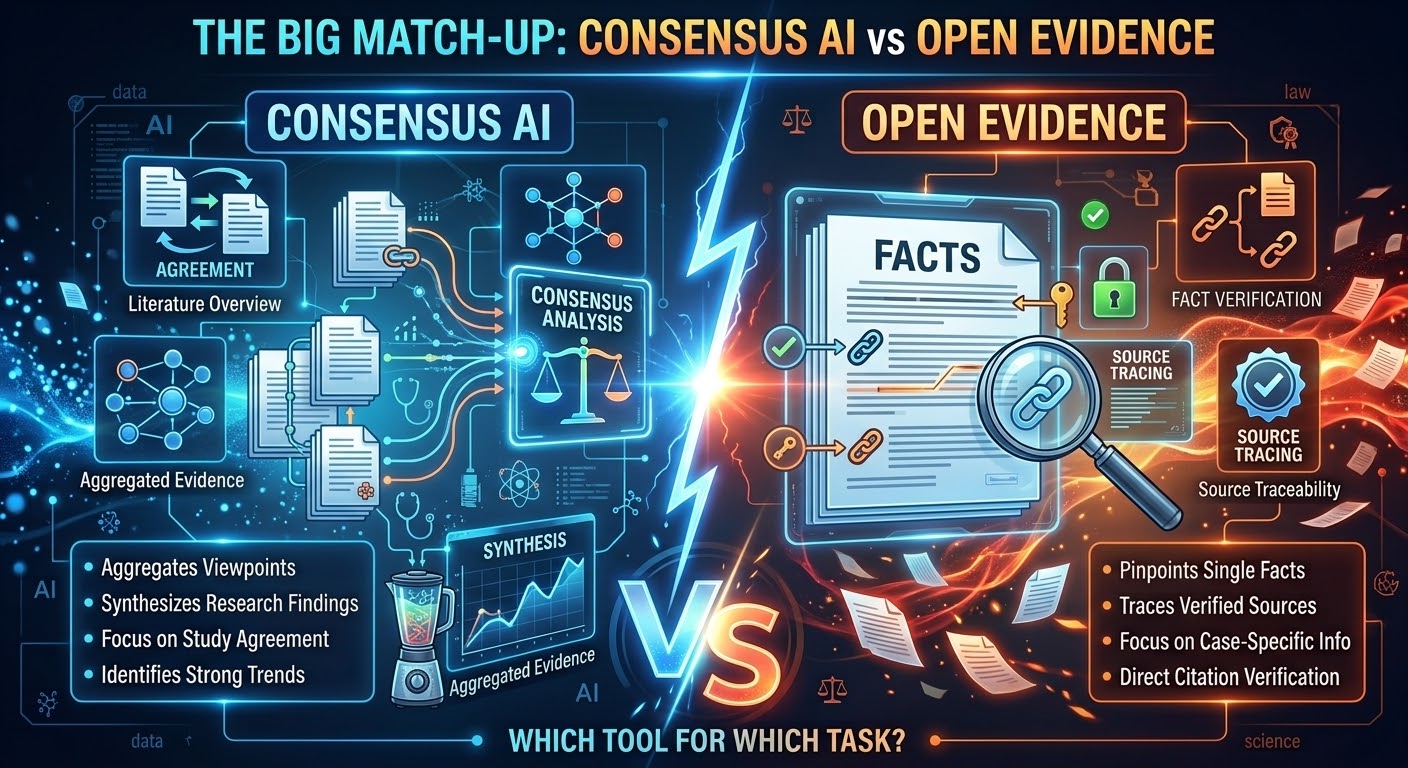
While both platforms utilize artificial intelligence trained on scientific literature, they serve completely different workflows. This comparison breaks down their key features, target audiences, data sources, and practical applications to help you choose the right tool for your clinical workflow or research stack.
Quick Verdict
Choose OpenEvidence if: You are a practicing physician, healthcare professional, or clinical resident needing rapid, point-of-care answers grounded in top-tier medical journals (NEJM, JAMA, Lancet) and official clinical guidelines.
Choose Consensus AI if: You are an academic researcher, medical student, or global health professional looking to conduct deep literature reviews, analyze study agreement across millions of papers, and filter results by study design or journal ranking.
In-Depth Analysis: OpenEvidence

OpenEvidence is engineered specifically for bedside and clinical consultation. It operates as an AI-powered decision-support engine trained exclusively on high-impact medical journals, clinical trials, and clinical guidelines.
Key Features
Clinical Focus: Answers are tailored specifically for healthcare workflows, prioritizing diagnostic criteria, management protocols, and treatment guidelines.
High-Impact Sourcing: Focuses heavily on authoritative journals such as The New England Journal of Medicine, JAMA, The Lancet, and specialty society guidelines.
Structured for Point-of-Care: Formats output to give doctors rapid, actionable summaries backed by direct inline citations.
Limitations
Access Control: Requires healthcare provider verification (such as a US NPI number), limiting immediate full utility for general students or non-credentialed users.
Narrow Clinical Scope: Optimized strictly for clinical medicine rather than general biomedical science research.
In-Depth Analysis: Consensus AI

Consensus AI functions as an academic search engine designed to accelerate literature reviews and scientific synthesis. Rather than focusing solely on clinical treatment recommendations, it evaluates scientific consensus across broad research areas.
Key Features
The Consensus Meter: Provides a visual summary indicating whether published studies agree, disagree, or remain inconclusive on a given research question.
Study Snapshots: Automatically extracts sample sizes, study methodologies (e.g., RCTs, meta-analyses), and key outcomes into clean preview cards.
Global Accessibility: Anyone can sign up and immediately search over 200 million research papers without medical credentialing.
Limitations
Not a Bedside Tool: Designed for literature synthesis rather than immediate clinical dosing or acute diagnostic recommendations.
Pro Features: Advanced paper synthesis and unlimited AI responses require a paid monthly plan.
Practical Application Scenarios
Scenario 1: Bedside Care during Hospital Rounds
Recommended Tool: OpenEvidence
Why: When a clinician needs to double-check management guidelines or verify drug interactions during patient care, OpenEvidence provides concise, highly relevant guidance in seconds.
Scenario 2: Writing a Seminar Paper or Systematic Review
Recommended Tool: Consensus AI
Why: When investigating whether a specific intervention shows statistical significance across 50+ published trials, Consensus AI’s Consensus Meter saves hours of manual article screening.
Final Verdict

Both platforms are essential tools in modern evidence-based medicine, but they sit at different stages of the knowledge pipeline. OpenEvidence is the premier choice for bedside clinical execution, while Consensus AI is the ideal engine for literature discovery and academic research synthesis.




Very impactful ariticle